Your own phones, or your company's fleet. Each has its own account.
New to Dashivo Pro? Talk to us and we'll set up your company.
Recording laws.
What each state's law means when you drive with Dashivo: sound, where to mount the phone, and police stops. All 50 states and DC.
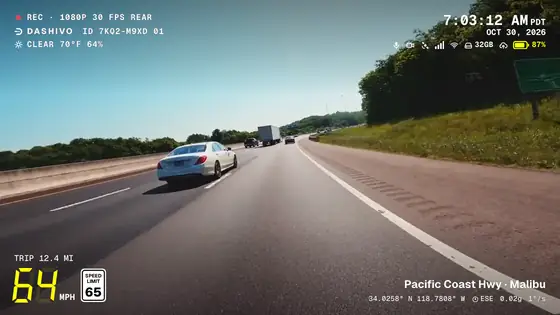
Dashivo™ records video, and sound unless you turn it off. Video on public roads is fine in every state. Sound is where the states differ, and so are the rules for a phone on the windshield.
This page is general information, not legal advice. Laws change, and courts read them in different ways. Before you rely on anything here, check the current statute or ask a lawyer licensed in your state. Angry Owl Labs LLC isn't a law firm.
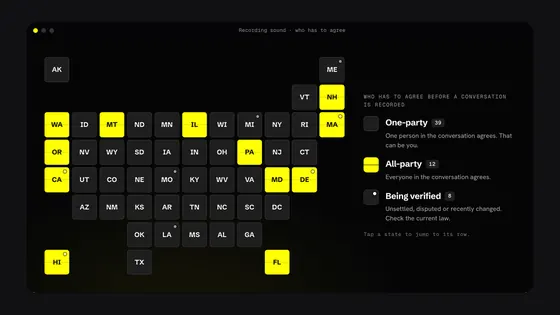
Who has to agree before a conversation is recorded
One-party 39One person in the conversation agrees. That can be you.
All-party 12Everyone in the conversation agrees.
Being verified 8Unsettled, disputed or recently changed. Check the current law.
Tap a state to jump to its row.
What to know before you record.
Rules of thumb for the US. Your state's own law is what counts, and this isn't legal advice.
Video: generally allowed on public roads.
Recording what anyone can see from a public road is generally allowed in the US. Places where people expect privacy are different: never point a camera into homes, bathrooms, changing rooms or anywhere like them.
The road, other cars, their platesGenerally fine
Officers doing their job in publicProtected by most federal courts
Into homes, bathrooms, changing roomsDon't
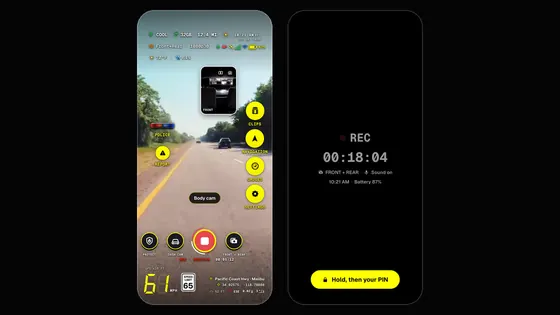
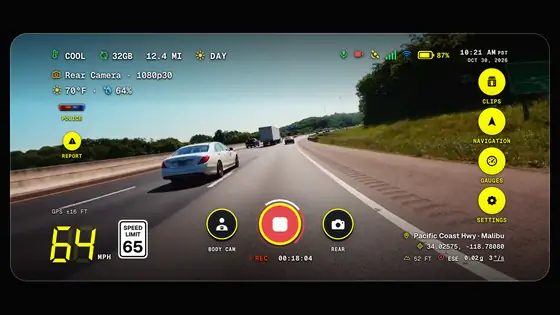
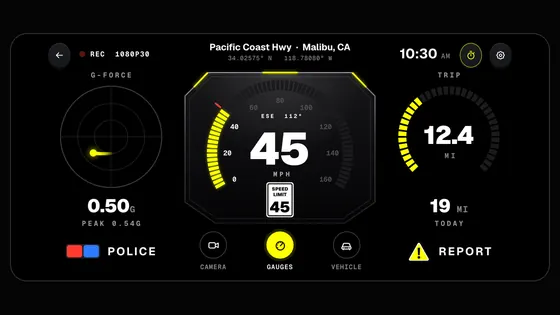
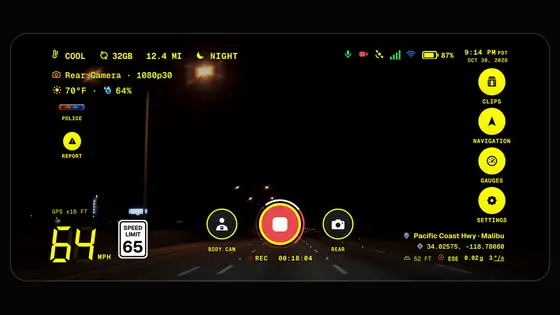
Every mode.Dash cam, body cam and Police stop all record video, stamped with the time and place.
Sound: the big difference.
Recording a conversation falls under consent laws, and the states split in two.
One-party
YouThem
One person in the conversation agrees. That can be you.
All-party
YouThemThem
Everyone in the conversation agrees.
In the table below
39 one-party12 all-party
39 of the 51 are one-party and 12 are all-party.
Record sound.On by default in Dashivo, in every mode. In an all-party state, tell everyone in the car before you record, or turn it off: Settings › Dash cam › Record sound.
Recording police
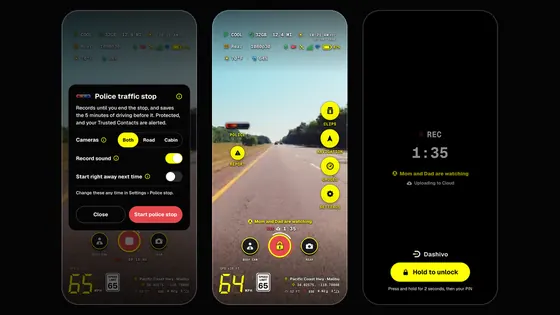
Most federal appeals courts say you may record police doing their job in public. In Dashivo, tap POLICE as you pull over, then keep your hands still and follow instructions. Sound still follows your state's rule.
Tell your passengers
With Front and rear on, the cabin camera records your riders. Tell them, and a sign in the car helps. In an all-party state, get their OK or turn off Record sound.
Mount it legally
Some states allow only certain spots on the windshield; your state's row below says where. A dash or console mount out of your line of sight is the safe choice anywhere.
Hands-free laws
Most states ban holding a phone while you drive. Dashivo starts recording when it opens, so set it up before you drive and leave it alone on the road.
Private places
Never point a camera into homes, bathrooms or changing rooms. Several states make that a crime even where sound is one-party.
Share with care
You're responsible for how you share footage of other people. Think twice before posting, and blur faces and plates.
Every state, compared.
Each state's sound rule with a link to the law, and what it means with Dashivo: Record sound with passengers, where to mount the phone, and a police stop.
General information only, and laws change. Check the current statute or ask a lawyer licensed in your state. Last reviewed:
Sound-recording consent by state, with the statute, a link to its source, and what it means for sound, the phone mount and police stops with Dashivo
Sound. One-party: you're in the conversation, so you can keep Record sound on with passengers. Secretly recording while trespassing in a private place is a separate crime.
Mount. Nothing on the windshield may block your clear view (Ala. Code 32-5-215). A mounted phone is fine; don't hold it (32-5A-350.1).
Police stop. The federal appeals court here (11th Circuit) protects recording police doing their job in public (Smith v. City of Cumming, 2000). Tap POLICE as you pull over.
Sound. One-party: you're in the conversation, so you can keep Record sound on with passengers. Recording other people's talk without a participant's consent is a crime.
Mount. Nothing on the windshield may block your view (13 AAC 04.225). Mount low or on the dash.
Police stop. The federal appeals court here (9th Circuit) protects recording police doing their job in public (Askins v. DHS, 2018). Tap POLICE as you pull over.
Sound. One-party: you're in the conversation, so you can keep Record sound on with passengers. The consent of anyone in the conversation, or anyone present, is enough.
Mount. Items may go in a 7-inch square in the lower corner farthest from you, a 5-inch square in the lower corner nearest you, or just behind the mirror for safety cameras (A.R.S. 28-959.01). Behind the mirror or the dash works best.
Police stop. The federal appeals court here (9th Circuit) protects recording police doing their job in public (Askins v. DHS, 2018). A 2022 law limiting recording within 8 feet of police is permanently blocked by a court. Tap POLICE as you pull over.
Sound. One-party: you're in the conversation, so you can keep Record sound on with passengers. Video voyeurism where people expect privacy is a felony.
Mount. Nothing may sit more than 4.5 inches above the bottom of the windshield if it blocks your view (A.C.A. 27-37-304). Mount low or on the dash.
Police stop. The federal appeals court here (8th Circuit) hasn't clearly recognized a right to record police, so record openly and don't interfere. Tap POLICE as you pull over.
Sound. All-party: tell everyone in the car before you record (a sign helps), or turn off Record sound in Settings › Dash cam. It covers talk people expect to stay private, which includes riders in your car.
Mount. Only a 7-inch square in the lower passenger-side corner, a 5-inch square in the lower driver-side corner, or a 5-inch square at top center, with a notice in the car that conversations may be recorded (Veh. Code § 26708). A phone you touch must be in a lower corner or on the dash (§ 23123.5).
Police stop. The federal appeals court here (9th Circuit) protects recording police doing their job in public (Askins v. DHS, 2018). Recording an officer in public isn't by itself obstruction (Penal Code § 148(g)). Tap POLICE as you pull over.
Sound. One-party: you're in the conversation, so you can keep Record sound on with passengers. The eavesdropping law only covers someone who isn't visibly present, so you, in the car, may record.
Mount. Your view through the windshield must stay unobstructed, and no zones are named (C.R.S. 42-4-201). Mount low or on the dash; since 2025 you may not hold the phone while driving (C.R.S. 42-4-239).
Police stop. The federal appeals court here (10th Circuit) protects recording police doing their job in public (Irizarry v. Yehia, 2022). State law protects recording police, and an officer who seizes or destroys your recording can owe you damages (C.R.S. 16-3-311, 13-21-128). Tap POLICE as you pull over.
Sound. One-party: you're in the conversation, so you can keep Record sound on with passengers. In person it's one-party. A phone call on speaker needs everyone's consent (civil).
Mount. Nothing attached may block your view or distract you (C.G.S. 14-99f). Mount low or on the dash, and don't hold the phone.
Police stop. The federal appeals court here (2nd Circuit) protects recording police doing their job in public (Massimino v. Benoit, 2026). Tap POLICE as you pull over.
Sound. All-party: tell everyone in the car before you record (a sign helps), or turn off Record sound in Settings › Dash cam. Two Delaware laws disagree and no court has settled it, so we list it as all-party to be safe.
Mount. Nothing non-transparent may go on the windshield (21 Del. C. § 4309). Use a dash or vent mount.
Police stop. The federal appeals court here (3rd Circuit) protects recording police doing their job in public (Fields v. City of Philadelphia, 2017). Tap POLICE as you pull over.
Sound. One-party: you're in the conversation, so you can keep Record sound on with passengers. Recording for a criminal or harmful purpose isn't allowed.
Mount. Nothing may block a significant part of your view to the front or sides (18 DCMR § 2213.1). Mount low or on the dash, and don't hold the phone (D.C. Code § 50-1731.04).
Police stop. The D.C. Circuit hasn't clearly recognized a right to record police, so record openly and don't interfere. Tap POLICE as you pull over.
Sound. All-party: tell everyone in the car before you record (a sign helps), or turn off Record sound in Settings › Dash cam. It covers talk people expect to stay private, which includes riders in your car.
Mount. Only required stickers, toll tags and GPS or safety devices may go on the windshield (Fla. Stat. 316.2952). Put the phone behind the mirror or on the dash.
Police stop. The federal appeals court here (11th Circuit) protects recording police doing their job in public (Smith v. City of Cumming, 2000). After a warning, staying within 25 feet of a first responder to interfere or harass is a misdemeanor (Fla. Stat. 843.31). Tap POLICE as you pull over.
Sound. One-party: you're in the conversation, so you can keep Record sound on with passengers. Video in a private place out of public view needs everyone's consent.
Mount. Georgia allows a windshield mount for a phone placed to block as little as possible (O.C.G.A. 40-8-73). Mount low or near the mirror; don't hold the phone.
Police stop. The federal appeals court here (11th Circuit) protects recording police doing their job in public (Smith v. City of Cumming, 2000). Tap POLICE as you pull over.
Sound. All-party: tell everyone in the car before you record (a sign helps), or turn off Record sound in Settings › Dash cam. A participant may record, but any recording device in a private place needs consent, so we list it as all-party to be safe.
Mount. Items may go in a 7-inch square in the lower corner farthest from you or a 5-inch square in the lower corner nearest you (HRS 291-21.5). Use one of those or the dash.
Police stop. The federal appeals court here (9th Circuit) protects recording police doing their job in public (Askins v. DHS, 2018). State law expressly allows recording police doing their duties in public. Tap POLICE as you pull over.
Sound. One-party: you're in the conversation, so you can keep Record sound on with passengers. Recording to commit a crime isn't allowed.
Mount. Nothing non-transparent may block your clear view (Idaho Code 49-943). Mount low or on the dash, and don't hold the phone.
Police stop. The federal appeals court here (9th Circuit) protects recording police doing their job in public (Askins v. DHS, 2018). Tap POLICE as you pull over.
Sound. All-party: tell everyone in the car before you record (a sign helps), or turn off Record sound in Settings › Dash cam. It covers private conversations, which includes riders in your car. Open recording, and police on duty in public, fall outside it.
Mount. Nothing may materially block your view through the windshield (625 ILCS 5/12-503). Mount low or on the dash, and don't hold the phone.
Police stop. The federal appeals court here (7th Circuit) protects recording police doing their job in public (ACLU v. Alvarez, 2012). Illinois law allows recording police on duty in public. Tap POLICE as you pull over.
Sound. One-party: you're in the conversation, so you can keep Record sound on with passengers. The law covers electronic communications; in-person talk is effectively one-party.
Mount. Small items may go in a 4-inch square in the lower corner farthest from you (IC 9-19-19-3). Use that corner or the dash; don't hold the phone.
Police stop. The federal appeals court here (7th Circuit) protects recording police doing their job in public (ACLU v. Alvarez, 2012). A 25-foot police buffer law is blocked by a court. Tap POLICE as you pull over.
Sound. One-party: you're in the conversation, so you can keep Record sound on with passengers. Recording other people's talk without a participant's consent is a crime.
Mount. The windshield must allow clear vision (Iowa Code 321.438). Mount low or on the dash; since 2025 you may not hold the phone.
Police stop. The federal appeals court here (8th Circuit) hasn't clearly recognized a right to record police, so record openly and don't interfere. Tap POLICE as you pull over.
Sound. One-party: you're in the conversation, so you can keep Record sound on with passengers. Recording sounds from a private place that you couldn't normally hear is banned.
Mount. Nothing may substantially block your clear view (K.S.A. 8-1741). Mount low or on the dash.
Police stop. The federal appeals court here (10th Circuit) protects recording police doing their job in public (Irizarry v. Yehia, 2022). Tap POLICE as you pull over.
Sound. One-party: you're in the conversation, so you can keep Record sound on with passengers. Eavesdropping on talk you're not part of is a felony.
Mount. Nothing on the windshield; use a dash or vent mount (KRS 189.110).
Police stop. The federal appeals court here (6th Circuit) hasn't clearly recognized a right to record police, so record openly and don't interfere. Tap POLICE as you pull over.
Sound. One-party, being verified: until it's settled, tell passengers the car records sound, or turn Record sound off (Settings › Dash cam › Record sound). A 2026 law requires notice before smart glasses record a conversation; it doesn't cover phones.
Mount. Nothing on the windshield may block your clear view (La. R.S. 32:361.1). Mount low or on the dash, and don't hold the phone (R.S. 32:59).
Police stop. The federal appeals court here (5th Circuit) protects recording police doing their job in public (Turner v. Driver, 2017). A 2024 law making people stay 25 feet back from police is blocked by a court while an appeal is pending. Tap POLICE as you pull over.
Sound. One-party, being verified: until it's settled, tell passengers the car records sound, or turn Record sound off (Settings › Dash cam › Record sound). Recording inside homes and other private places needs the consent of the people there.
Mount. Nothing on the windshield may block your clear view (29-A M.R.S. § 2082). Mount low or on the dash.
Police stop. The federal appeals court here (1st Circuit) protects recording police doing their job in public (Glik v. Cunniffe, 2011). Tap POLICE as you pull over.
Sound. All-party: tell everyone in the car before you record (a sign helps), or turn off Record sound in Settings › Dash cam. It covers conversations where people expect privacy, and breaking it is a felony.
Mount. Items on the glass must fit in a 7-inch square in a lower corner (Transp. § 21-1104). Use the lower passenger-side corner or the dash.
Police stop. The federal appeals court here (4th Circuit) protects recording police doing their job in public (Sharpe v. Town of Winterville, 2023). Tap POLICE as you pull over.
Sound. All-party: tell everyone in the car before you record (a sign helps), or turn off Record sound in Settings › Dash cam. The law bans secret recording, so record openly: tell riders, or turn off Record sound.
Mount. A phone may be mounted on the windshield, dash or console if it doesn't get in your way (G.L. c. 90 § 13B).
Police stop. The federal appeals court here (1st Circuit) protects recording police doing their job in public (Glik v. Cunniffe, 2011). The court also struck the ban on secretly recording police in public (2020). Tap POLICE as you pull over.
Sound. One-party, being verified: until it's settled, tell passengers the car records sound, or turn Record sound off (Settings › Dash cam › Record sound). A Michigan appeals court (1982) and a federal trial court (March 2026) let a person in the conversation record. That federal ruling may be appealed, and the Michigan Supreme Court has never ruled.
Mount. No object may block your view through the windshield (MCL 257.709). A dash mount is safest; don't hold the phone (MCL 257.602b).
Police stop. The federal appeals court here (6th Circuit) hasn't clearly recognized a right to record police, so record openly and don't interfere. Tap POLICE as you pull over.
Sound. One-party: you're in the conversation, so you can keep Record sound on with passengers. Talk with no reasonable expectation of privacy isn't protected at all.
Mount. A navigation device may sit near the bottom of the windshield, and safety cameras just behind the mirror (Minn. Stat. 169.71). Either spot works.
Police stop. The federal appeals court here (8th Circuit) hasn't clearly recognized a right to record police, so record openly and don't interfere. Tap POLICE as you pull over.
Sound. One-party: you're in the conversation, so you can keep Record sound on with passengers. Recording for a criminal or harmful purpose isn't allowed.
Mount. The law bans signs and stickers on the windshield and says nothing about mounts. Keep it low and out of your view, or on the dash.
Police stop. The federal appeals court here (5th Circuit) protects recording police doing their job in public (Turner v. Driver, 2017). Tap POLICE as you pull over.
Sound. One-party, being verified: until it's settled, tell passengers the car records sound, or turn Record sound off (Settings › Dash cam › Record sound). Phone and in-person talk are both one-party. Live-streaming someone else's private talk is a grey area.
Mount. Items are allowed if they don't block your normal view (RSMo 307.173). Mount low or on the dash, and don't hold the phone (RSMo 304.822).
Police stop. The federal appeals court here (8th Circuit) hasn't clearly recognized a right to record police, so record openly and don't interfere. Tap POLICE as you pull over.
Sound. All-party: tell everyone in the car before you record (a sign helps), or turn off Record sound in Settings › Dash cam. Montana bans hidden recording: tell riders the car records sound, or turn off Record sound.
Mount. Nothing on the windshield may materially block your view (MCA 61-9-405). Mount low or on the dash.
Police stop. The federal appeals court here (9th Circuit) protects recording police doing their job in public (Askins v. DHS, 2018). Tap POLICE as you pull over.
Sound. One-party: you're in the conversation, so you can keep Record sound on with passengers. Recording for a criminal or harmful purpose isn't allowed.
Mount. Only objects that significantly block your view are banned (Neb. Rev. Stat. 60-6,256). Low on the glass or the dash is fine.
Police stop. The federal appeals court here (8th Circuit) hasn't clearly recognized a right to record police, so record openly and don't interfere. Tap POLICE as you pull over.
Sound. One-party: you're in the conversation, so you can keep Record sound on with passengers. In-person talk is one-party. Phone calls on speaker in the car need everyone's consent.
Mount. One spot is allowed: a 6-inch square in the lower corner farthest from you (NRS 484D.435). Use the lower passenger-side corner or the dash.
Police stop. The federal appeals court here (9th Circuit) protects recording police doing their job in public (Askins v. DHS, 2018). Tap POLICE as you pull over.
Sound. All-party: tell everyone in the car before you record (a sign helps), or turn off Record sound in Settings › Dash cam. Recording without everyone's consent where they expect privacy is a crime.
Mount. Nothing on the windshield may block your clear view (RSA 265:95). Mount low or on the dash, and don't hold the phone.
Police stop. The federal appeals court here (1st Circuit) protects recording police doing their job in public (Glik v. Cunniffe, 2011). Tap POLICE as you pull over.
Sound. One-party: you're in the conversation, so you can keep Record sound on with passengers. Recording for a criminal or harmful purpose isn't allowed.
Mount. Nothing non-transparent is allowed on the windshield (N.J.S.A. 39:3-74). Use the dash, or just behind the mirror.
Police stop. The federal appeals court here (3rd Circuit) protects recording police doing their job in public (Fields v. City of Philadelphia, 2017). Tap POLICE as you pull over.
Sound. One-party: you're in the conversation, so you can keep Record sound on with passengers. A state court held that recording a face-to-face talk isn't criminal eavesdropping.
Mount. Nothing may sit on the windshield below the top 5 inches (NMSA 66-3-846). Mount at the very top or on the dash.
Police stop. The federal appeals court here (10th Circuit) protects recording police doing their job in public (Irizarry v. Yehia, 2022). Tap POLICE as you pull over.
Sound. One-party: you're in the conversation, so you can keep Record sound on with passengers. Eavesdropping on talk you're not part of is a felony.
Mount. Nothing may block your view through the windshield (VTL § 375). Mount low or on the dash, and don't hold the phone.
Police stop. The federal appeals court here (2nd Circuit) protects recording police doing their job in public (Massimino v. Benoit, 2026). State law also protects your right to record police (Civil Rights Law § 79-p). Tap POLICE as you pull over.
Sound. One-party: you're in the conversation, so you can keep Record sound on with passengers. Recording talk you're not part of, without a participant's consent, is a felony.
Mount. North Carolina has no general windshield rule for mounts. Keep it low and out of your line of sight.
Police stop. The federal appeals court here (4th Circuit) protects recording police doing their job in public (Sharpe v. Town of Winterville, 2023). Tap POLICE as you pull over.
Sound. One-party: you're in the conversation, so you can keep Record sound on with passengers. Recording to commit a crime or harm isn't allowed.
Mount. Nothing on the windshield; use a dash or vent mount (NDCC 39-21-39).
Police stop. The federal appeals court here (8th Circuit) hasn't clearly recognized a right to record police, so record openly and don't interfere. Tap POLICE as you pull over.
Sound. One-party: you're in the conversation, so you can keep Record sound on with passengers. Recording for a criminal or harmful purpose is a felony.
Mount. Devices on the windshield are allowed if they don't block your view of the road and signs (R.C. 4513.24).
Police stop. The federal appeals court here (6th Circuit) hasn't clearly recognized a right to record police, so record openly and don't interfere. Tap POLICE as you pull over.
Sound. One-party: you're in the conversation, so you can keep Record sound on with passengers. Recording for a criminal purpose isn't allowed.
Mount. No object may materially block your view (47 O.S. § 12-404). Mount low or on the dash.
Police stop. The federal appeals court here (10th Circuit) protects recording police doing their job in public (Irizarry v. Yehia, 2022). Since 2025, ignoring an order to stay 25 feet from a first responder is a crime. Tap POLICE as you pull over.
Sound. All-party: tell everyone in the car before you record (a sign helps), or turn off Record sound in Settings › Dash cam. In person, you must tell everyone before you record; a federal appeals court upheld this in 2025. Phone calls are one-party.
Mount. Nothing may block seeing into or out of the car through the windshield (ORS 815.220). A dash or vent mount is safest.
Police stop. The federal appeals court here (9th Circuit) protects recording police doing their job in public (Askins v. DHS, 2018). State law lets you openly record an officer on duty in public. Tap POLICE as you pull over.
Sound. All-party: tell everyone in the car before you record (a sign helps), or turn off Record sound in Settings › Dash cam. It covers conversations where people expect privacy, and breaking it is a felony.
Mount. Nothing may materially block your view through the windshield (75 Pa.C.S. § 4524). Mount low or on the dash, and don't hold the phone.
Police stop. The federal appeals court here (3rd Circuit) protects recording police doing their job in public (Fields v. City of Philadelphia, 2017). Tap POLICE as you pull over.
Sound. One-party: you're in the conversation, so you can keep Record sound on with passengers. Recording for a criminal or harmful purpose isn't allowed.
Mount. Nothing on the windshield may block your clear view (R.I. Gen. Laws § 31-23-16). Mount low or on the dash.
Police stop. The federal appeals court here (1st Circuit) protects recording police doing their job in public (Glik v. Cunniffe, 2011). Tap POLICE as you pull over.
Sound. One-party: you're in the conversation, so you can keep Record sound on with passengers. Spying on people where they expect privacy is a separate crime.
Mount. Nothing on the windshield may block your clear view (S.C. Code § 56-5-5000). Mount low or on the dash; the 2025 hands-free law bans holding the phone.
Police stop. The federal appeals court here (4th Circuit) protects recording police doing their job in public (Sharpe v. Town of Winterville, 2023). Tap POLICE as you pull over.
Sound. One-party: you're in the conversation, so you can keep Record sound on with passengers. Recording talk you're not part of without a participant's consent is a felony.
Mount. Nothing may dangle between you and the windshield (SDCL 32-15-6). A firm mount low on the glass or on the dash is fine.
Police stop. The federal appeals court here (8th Circuit) hasn't clearly recognized a right to record police, so record openly and don't interfere. Tap POLICE as you pull over.
Sound. One-party: you're in the conversation, so you can keep Record sound on with passengers. Recording for a criminal or harmful purpose isn't allowed.
Mount. The hands-free law allows a phone in a mount that doesn't block your view (Tenn. Code 55-8-199). Mount low or on the dash.
Police stop. The federal appeals court here (6th Circuit) hasn't clearly recognized a right to record police, so record openly and don't interfere. Since 2025, police may order people to stay 25 feet back; a court let that law stand in 2026. Tap POLICE as you pull over.
Sound. One-party: you're in the conversation, so you can keep Record sound on with passengers. Recording for an unlawful purpose isn't allowed.
Mount. Nothing may block or reduce your clear view through the windshield (Transp. Code § 547.613). Mount low or on the dash.
Police stop. The federal appeals court here (5th Circuit) protects recording police doing their job in public (Turner v. Driver, 2017). Tap POLICE as you pull over.
Sound. One-party: you're in the conversation, so you can keep Record sound on with passengers. Hidden recording devices in private places are banned.
Mount. Mounted devices must not materially block your view (Utah Code 41-6a-1635). The top strip of the glass, near the mirror, or the dash works.
Police stop. The federal appeals court here (10th Circuit) protects recording police doing their job in public (Irizarry v. Yehia, 2022). Tap POLICE as you pull over.
Sound. One-party: you're in the conversation, so you can keep Record sound on with passengers. Vermont has no eavesdropping law; the federal one-party rule applies.
Mount. Only small zones are allowed on the glass, such as the lower corner on the passenger side (23 V.S.A. § 1125). Mount there or on the dash.
Police stop. The federal appeals court here (2nd Circuit) protects recording police doing their job in public (Massimino v. Benoit, 2026). Tap POLICE as you pull over.
Sound. One-party: you're in the conversation, so you can keep Record sound on with passengers. Filming people undressed without consent is a separate crime.
Mount. A dash cam may sit mostly hidden behind the rear-view mirror (Va. Code § 46.2-1054). Put the phone there or on the dash.
Police stop. The federal appeals court here (4th Circuit) protects recording police doing their job in public (Sharpe v. Town of Winterville, 2023). Tap POLICE as you pull over.
Sound. All-party: tell everyone in the car before you record (a sign helps), or turn off Record sound in Settings › Dash cam. A recorded announcement to everyone counts as consent, so tell riders when the ride starts.
Mount. Nothing on the windshield may block your clear view (RCW 46.37.410). Mount low or on the dash.
Police stop. The federal appeals court here (9th Circuit) protects recording police doing their job in public (Askins v. DHS, 2018). Tap POLICE as you pull over.
Sound. One-party: you're in the conversation, so you can keep Record sound on with passengers. Courts treat homes as strongly private.
Mount. Nothing on the windshield may block your clear view (W. Va. Code § 17C-15-36). Mount low or on the dash.
Police stop. The federal appeals court here (4th Circuit) protects recording police doing their job in public (Sharpe v. Town of Winterville, 2023). Tap POLICE as you pull over.
Sound. One-party: you're in the conversation, so you can keep Record sound on with passengers. Recording talk you're not part of is a felony.
Mount. Nothing on the windshield; use a dash or vent mount (Wis. Stat. § 346.88).
Police stop. The federal appeals court here (7th Circuit) protects recording police doing their job in public (ACLU v. Alvarez, 2012). Tap POLICE as you pull over.
Sound. One-party: you're in the conversation, so you can keep Record sound on with passengers. Secret recording in enclosed private spaces is banned.
Mount. Nothing on the windshield may materially block your view (Wyo. Stat. § 31-5-955). Mount low or on the dash.
Police stop. The federal appeals court here (10th Circuit) protects recording police doing their job in public (Irizarry v. Yehia, 2022). Tap POLICE as you pull over.
No state matches that.
Read the law itself. Every state publishes its laws on its legislature's website: look up the statute named in the table there for the current text. Every state links to its own law: the legislature's code site, or the publisher the state names for its code. Vermont has no statute of its own, so it links to the federal law.
 Coming