Sign in to which Dashivo?
Your own phones, or your company's fleet. Each has its own account.
New to Dashivo Pro? Talk to us and we'll set up your company.
Night mode
Yellow readouts after sunset, white by day.
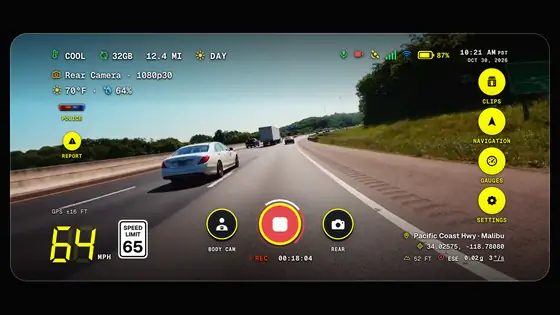
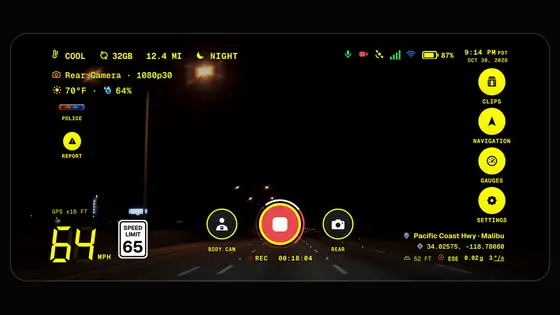
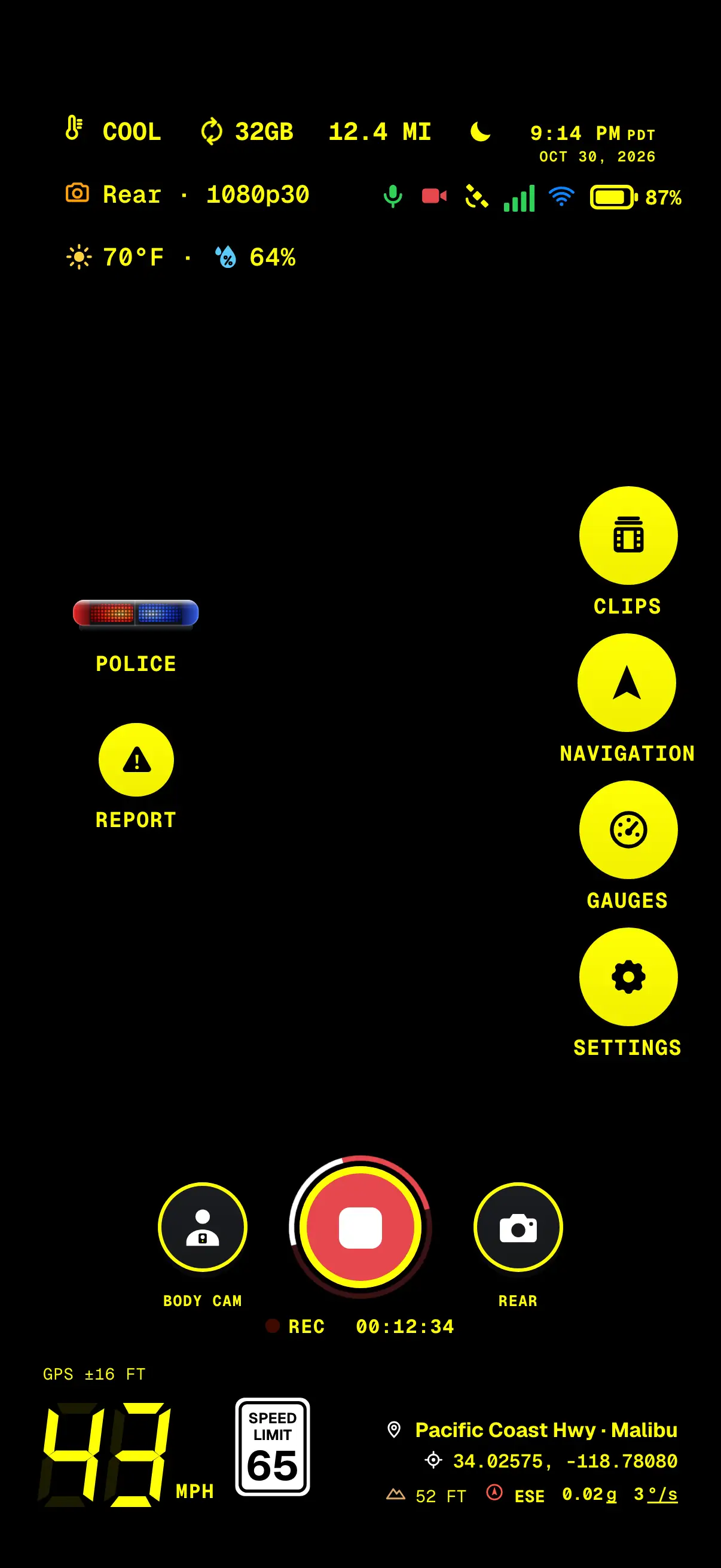
Night mode is how the HUD looks after dark. On Automatic, Dashivo™ turns the readouts our yellow once the sun is down where you are, and back to white at sunrise. Dim them in five steps, and the camera picture too if you like. Recordings never change. For the picture itself, the Low-light camera moves to the main lens when the road goes dark.
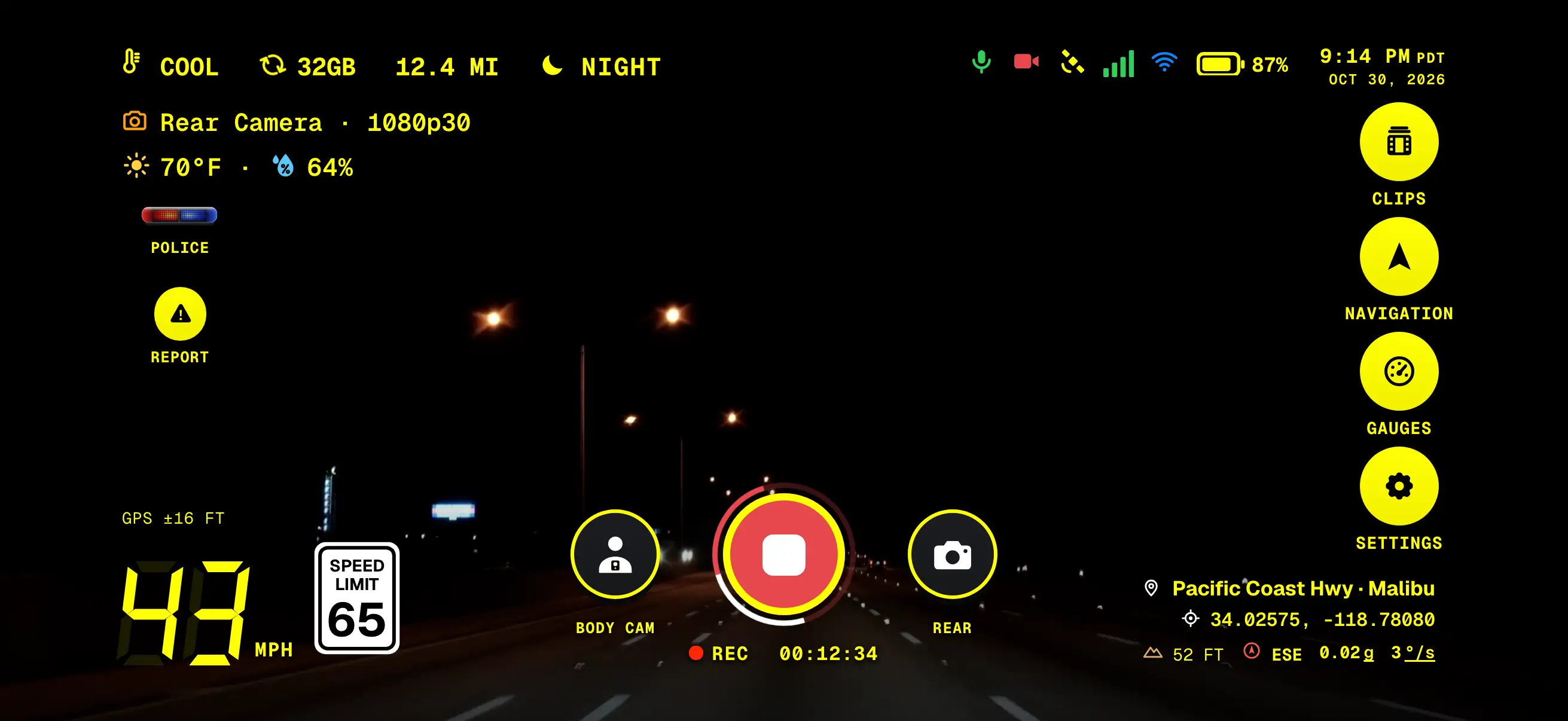
- The time of dayA moon after dark, a sun by day. Sideways, its word too: DAWN, DAY, DUSK or NIGHT.
- Yellow wordsEvery readout turns our yellow after sunset. Icons keep their own colours.
- Speed & limitThe digits and the sign stay sharp, with a faint black shadow over the dark road.
- Clock & dateThe same time and date the stamp burns into the video.
- The railRound yellow buttons with black icons, readable day and night.
- Where you areStreet and city, the coordinates, elevation and heading.
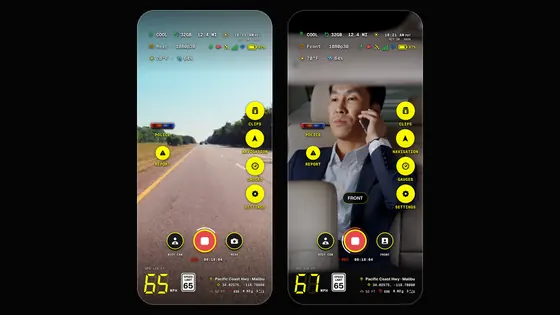
The app's camera screen after sunset, drawn with sample data over a licensed night road clip. In the app, the picture behind it is your camera.
The night look
- Automatic
- The default. Yellow while the sun is below the horizon where you are, white from sunrise to sunset. Without a location yet, it goes by the clock.
- Always on, or Off
- Always on keeps the night look day and night; Off keeps the day colours all the time.
- 5 levels
- Level 1 is full brightness. Levels 2 to 5 dim the words and icons together, down to about half, the lowest that still reads at a glance.
- The picture too
- Dim the camera picture too, if you like. It's off to start.
- See it first
- A before-and-after preview on a night road shows each level before you pick it.
- Recordings stay the same
- It changes only what your screen shows. The video and its stamp are never dimmed.
Settings › Dash & body cam › Night mode, on iPhone and Android.
The Low-light camera
- Main lens
- Recording Wide, the view slides over to the main lens after dark, which takes in several times more light. On Normal, you're on it already.
- Brighter
- The phone brightens the picture where it can, on iPhones that support it.
- Cleaner
- On Android, the noise reduction works harder too.
- No break
- It changes without stopping the recording, and switches back on its own in daylight.
- Brighter at night
- Optional, off to start: 24 frames a second after dark, so each frame gathers a little more light. Fast motion looks slightly softer.
- On by default
- Settings › Video › Low-light camera. Off keeps the same camera settings day and night.
Which phones do best at night
What decides night footage is how much light reaches the camera: a large main sensor and a bright lens, with optical stabilization to hold the picture steady through each frame. Software can't make up for a small sensor; it only trades grain for smear.
The app's phone check tells you plainly how yours does at night, and which phones work lists the ones we recommend. In body cam mode, the front camera is smaller and dimmer, so at night it needs whatever light the cabin has.
How it works
- 01
Leave Night mode on Automatic (the default) and drive as usual.
- 02
Once the sun is down where you are, the readouts turn yellow. At sunrise they go back to white.
- 03
When the camera has seen the dark for 8 seconds, the Low-light camera moves to the main lens.
- 04
Headlights, a tunnel or a gas station don't change it: the lens only switches back after 20 seconds of clear light.
Where it stands
Works today
- Night mode on iPhone and Android: Automatic, Always on or Off, with 5 levels
- The Low-light camera, on by default
- The phone check's night rating, in the app
- Readouts with a black shadow: faint at night, stronger over bright patches
The lens, judged by
the camera itself.
The night look follows the sun; the Low-light camera follows the picture. It reads how bright the scene is from the camera's own exposure: 8 seconds of darkness moves it to the main lens, and 20 seconds of clear light moves it back, so headlights, a tunnel or a gas station don't flip it back and forth.
Scene brightness from the camera's own exposureIllustration of an example drive, with example timings
- 8 s darkmoves it to the main lens.
- Headlightsa few seconds of glare don't count.
- Gas station12 s of light is under 20: it stays on.
- 20 s litmoves it back again.
Dark roads,
bright skies.
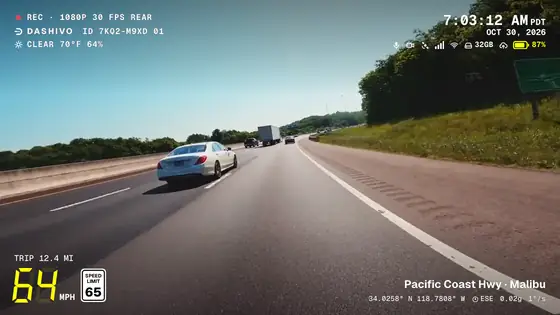
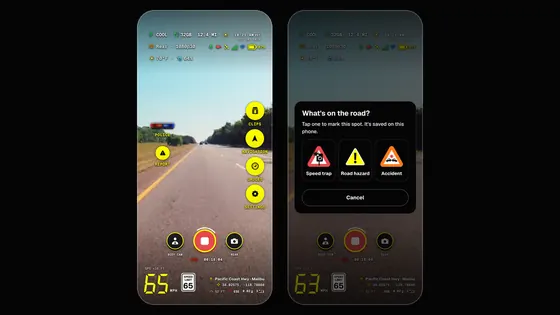
After sunset the words turn yellow; by day they're white. Every readout also carries a black shadow, a tight edge and a soft glow. On a dark road it stays faint, so the picture stays clear; over a bright patch, like the sky or a white car, it grows stronger, and it eases back once the picture is darker again.
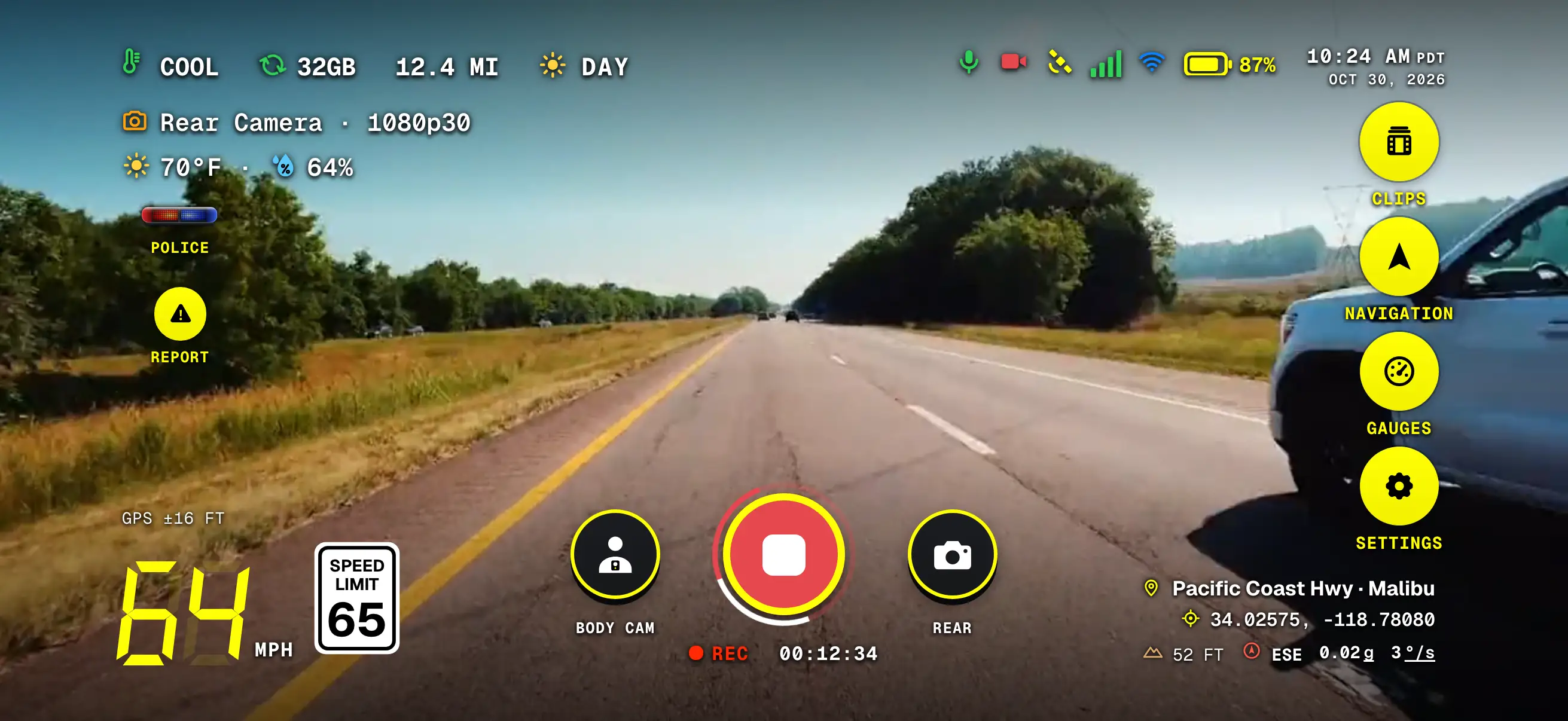
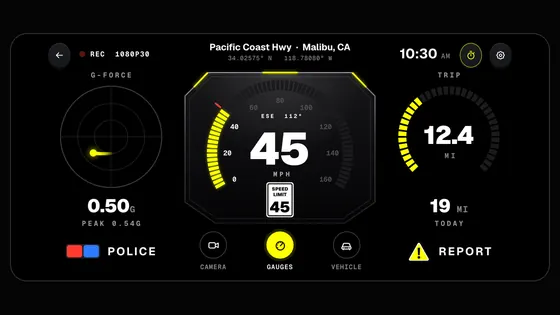
The app's camera screen drawn with sample data. The night road behind the first is added for this page; the second has a licensed road clip as the camera.
 Coming